Subdivisions and Amalgamations
Subdivisions
Property subdivision is the legal process of dividing one parcel of land into multiple independent lots, each issued with a separate title. There are 3 types of subdivision:
- Green Title - A Green Title (freehold) subdivision involves dividing a parcel of land into separate, independently owned lots, with no shared services, common property, or joint ownership arrangements.
- Survey Strata - A survey-strata subdivision splits a block of land into individually owned lots using surveyed boundaries instead of building outlines. Owners can share features such as driveways and utilities, which makes this type of subdivision a common option for Perth developments.
- Built Strata Subdivision - A built strata subdivision uses the completed buildings to determine the boundaries of each lot. Once construction is finished, individual titles can be created for the lots and any shared common areas.
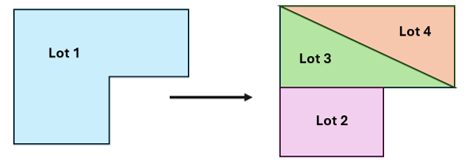
Example of Subdivision. Lot 1 has been subdivided into Lot 2, 3 and 4. These new lots now have separate titles and will also have separate rates notices.
Amalgamations
Amalgamation of land is the process of combining two or more adjoining lots (titles) into a single lot and title. In simple terms, if you own neighbouring blocks of land and want them to become one larger property with one title, you can apply for an amalgamation.
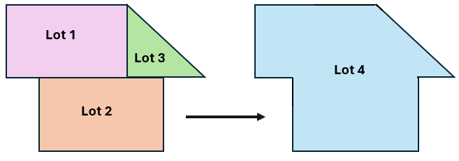
Below is an example of Amalgamation. Lot 1, 2 and 3 have now been amalgamated to Lot 4. All 3 lots that previously sat under different rates notices and titles now sit under only 1.
Applying for a Subdivision or Amalgamation
In order to apply, you must first apply through the WAPC (WA Planning Commission). In order to apply for a subdivision or amalgamation in Western Australia, you need to submit:
- A completed Form 1A
- Pay the correct application fee
- Copies of the subdivision plan:
- 8 copies if creating 40 lots or fewer
- 12 copies if creating more than 40 lots
- Any supporting documents
The application must be signed by:
- The applicant
- All landowners (or their authorised agents)
If the land includes Crown land, you must:
In your application, the plans provided must be based on a current and accurate feature survey showing things like Buildings, Driveways, etc (except for simple amalgamations, where feature survey isn’t required). It must also be clearly stated what type of subdivision you will be applying for (freehold, survey strata, survey strata). Each type of subdivision requires a separate application. It's also advised to check whether any restrictive covenants affect the property as these may create legal obligations. You can find more information about restrictive covenants by looking at the restrictive covenants facts sheet.
Depending on the site, you may be asked to provide additional information to WAPC such as:
- Earthworks or filling/excavation
- Stormwater drainage
- Water, sewer, electricity and gas services
- Heritage issues
- Environmental features
- Wetlands, rivers and native vegetation
- Previous land uses
- Contaminated sites
- Bushfire risk assessments
- Structure plans
- Proposed staging of the subdivision
What happens after you submit your application?
Firstly, WA Planning Commission will contact the relevant authorities (Water Corporation, Western power, etc), this includes the Shire of Cuballing. The Shire is to comment on whether or not the subdivision or amalgamation aligns with factors such as Local Planning Schemes, Structure plans and residential design codes.
After evaluating factors such as Planning schemes, WAPC policies, agency comments and site conditions, WAPC will decide to:
- Approve the application
- Approve the application but with conditions
- Refuse the Application
When the application is approved with conditions, you must ensure that all approval conditions endorsed by the Shire of Cuballing, utility providers and other government agencies are adhered to.
Once the conditions have been met, WAPC endorse the subdivision/amalgamation plan, Landgate certifies the plan and then you can apply for new titles through Landgate. More information on how to apply for new titles can be found at Application for New Titles | Landgate. You must apply for titles within 2 years of the WAPC endorsement.
What Happens if I disagree with the WAPC Decision ?
If your application is refused and you are not happy with the decision made by WAPC, you can:
- request a reconsideration from WAPC
- Submit Form 3A
- Make the request within 28 days
- Pay the required fees
- Appeal to SAT (state administrative tribunal)
- Apply to SAT within 28 days, more information can be found at Appeals from SAT Decisions
Contiguous Rating (Group Rating)
Contiguous Rating refers to the grouping of touching or adjacent properties under the same ownership being valued or rated as one. This means separate titles or lots are rated under the same assessment number and share one valuation, which supplied by Landgate. Land may be deemed contiguous if:
- Survey boundaries abut or are directly adjoining.
- Properties or lots are separated only by a road reserve, drainage reserve, or watercourse reserve.
- A property is used and occupied as a single holding and would reasonably be expected to be marketed and sold as one landholding, even where the boundaries do not physically adjoin.
Below are some examples where a Contiguous Rating is acceptable.
How to apply for a Contiguous Rating
In order to apply for a contiguous rating, you will need to submit a request in writing to the Shire of Cuballing. You must include the applicable property details such as Certificate of Title numbers, deposited plan numbers, etc. Once lodgement has been made at the Shire of Cuballing, the application will go to next Shire Council Meeting. From there, the application will either be approved or denied.
Is there a cost to contiguously rate your property?
There is currently no cost to apply for a contiguous rating.